

Alibaba Nanhu Future Science Park – Hangzhou
Matrix Design integrates the “Five Senses Design” concept into a science and technology park in Hangzhou, combining nature and technology for a unique and functional workspace promoting innovation and exploration.
In order to present a unique science and technology park of oriental style and make the space agree with human and nature, Matrix Design use “Five Senses Design” and modular research to build a first place where design can promote technological development.
The project is located in Nanhu Science Center, Yuhang District, Hangzhou, with Banqiao Mountain and Shaojian Mountain in the west, Bantian Mountain and Tortoise Mountain in the north, and Nanhu Lake in the northeast on both sides of the road. Shaped by its beautiful scenery and scientific functions, it is a real scientific industry park among mountains and water.
Entering the lobby through the visitors center, “five senses” concept can be felt. When visitors step into the lobby through the visitors center, visitors can suddenly get the core of company culture of exploring the unknown by seeing the “shadows swaying” made be falsified multimedia, hearing the rustle of leaves accompanied by white noise, feeling the natural breeze simulated by ventilation system, smelling fragrance of grass and trees and cultivating the experience immune to the secular world created by the former four senses.
For the atrium of visitors center, Matrix Design redesigns the original scissors stairs, whose major structure is similar to Mobius ring invented by German mathematician Mobius. The stairs are like a flowing line which starts from the first floor to the third floor. It not only has the basic functions, but also rich the layers of the architectural management area, making the space full of fun and symbolizing the endless scientific exploration.
In the main office area, the team takes flexible and incremental as the core of design logic. The open office area is designed with low saturation of concrete and wood to preserve a large area of open space. Soft isolation between different groups can be realized by functional rooms (negotiation room, telephone room, group exclusive meeting room).
Through the in-depth study of the grid-layout strong and weak electricity on the ground and the modules of independent office and meeting, the team not only gives a variety of possible changes in the form and perspective among modules in the final layout, but also realize the function exchange between open office area and meeting area in the case of increasing staff. The design allows around 15% increasing office cubicles without giving up any functions, laying a solid foundation for later development and benign operation.
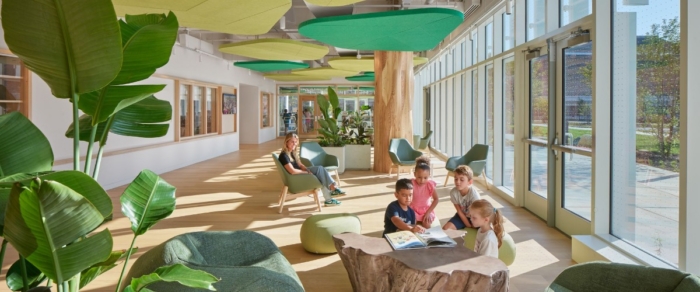
The design team selected the best landscape in all office buildings of the project, and will build the interior plant landscape area and multi-functional office space, combined with the unique exterior landscape to form an extension of ecological experience, which is available for temporary office, discussion and small meetings, etc. Without going outdoors, people can change their working mood by choosing new working environment, creating a relaxed, pleasant atmosphere for research and development work.
Design: Matrix Design
Photography: Interpretation & Sublimation










Now editing content for LinkedIn.