
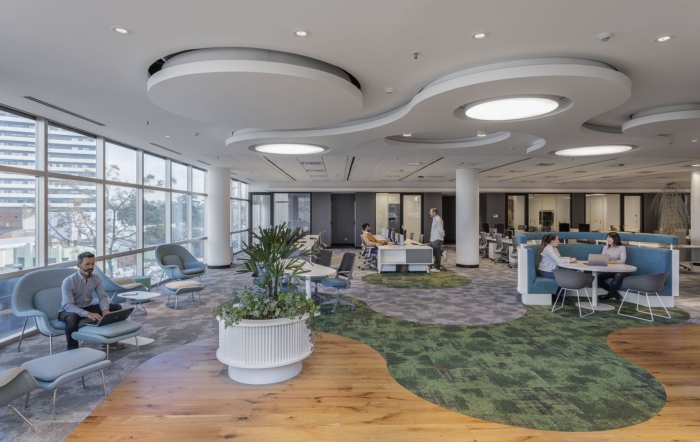
Supermayorista Vital Offices – Buenos Aires
Contract Workplaces reimagined the Supermayorista Vital offices in Buenos Aires, seamlessly merging modern design with collaboration-focused spaces to transform work culture and enhance spatial connectivity across 5,000 square-meters.
The project for Supermayorista Vital, an Argentine company and a leader in the sale and distribution of mass-consumption products, began with the need to reorganize its work environment and enhance its spatial impact. The main objective was to modernize the 5,000 m² of the existing building—composed of four levels and a basement—in order to adapt it to new work dynamics and update its image.
To support them in this process, Vital engaged Contract Workplaces, which initiated the task with a series of workshops led by its Workplace Management team. The purpose was to define the values and dynamics that would be present in the new workspace.
From the beginning, the symbolic importance of the building was recognized, and it was proposed to maximize its potential through horizontal, open, and flexible spaces. The first design decision was to reorganize the internal circulation, moving it toward the four-level central atrium to create a cardinal space: the “Vital” ecosystem. This area, intended to encourage interaction, integration, and collaboration among staff in an informal and welcoming environment, is composed of plazas or “agoras” on each floor that open to the central void. All workspaces were designed in relation to these plazas, which were equipped with different furniture systems revolving around a coffee point.
To connect these spaces, a large wooden staircase with tall lateral enclosures was designed to span the different levels. This sculptural construction culminates in a bridge that links two previously separated areas, creating a meeting point that also allows views to the exterior.
The ground floor was conceived as a central plaza, with a tall-canopy tree as a focal point and circular bleachers that function as a meeting space in front of a large media wall. At the back, a café serves the users of this sector.
On each of the upper floors, the operational areas were arranged at the center of the plan, in direct relation to the collaboration zone. The space was configured as an open plan, made up of ergonomic work islands. Meeting rooms of various sizes, adapted to the different needs of the staff, were positioned along the party wall. This sector also houses support programs such as a copy area, lockers, storage, and server rooms.
The fourth level stands out with its terrace connected to the dining area, featuring a wood-like deck and a variety of outdoor furniture, ranging from domestic-style chairs and tables that humanize the space to urban-scale concrete elements.
A key element of the design was the integration of art, with works by emerging artists selected through a national competition. These pieces are distributed throughout the building, creating a visual journey that enriches the work environment, making it more inspiring and creative.
The chosen color palette leans toward neutral tones—grays and whites—with wood accents to convey the seriousness of the company and highlight the artworks displayed in the office. The main staircase and the floors of the collaboration areas are clad in natural wood. To complete the aesthetic of these areas, the vertical surfaces were covered with white micro-ribbed sheet metal up to the ceiling, where different circular geometries in translucent and opaque fabric unfold. The enclosed meeting rooms were built with black double-glass partitions and sound-absorbing finishes to ensure acoustic comfort; all of them are equipped with state-of-the-art teleconferencing and digital projection systems.
The project also preserved some original elements of the building, such as the marble flooring on the ground floor, complementing it with black glass panels that create striking contrasts. The concrete structure of columns and beams was exposed to add an industrial and modern touch.
Finally, a specialized team redesigned the outdoor spaces and replanted native vegetation, strengthening the connection with nature across all levels.
As a result of this intervention, the renovation of Supermayorista Vital’s offices not only modernized the building but also transformed its work culture, aligning corporate values with an innovative, open, and collaborative environment. A truly “Vital” office.
Design: Contract Workplaces
Photography: Andrés Negroni












Now editing content for LinkedIn.