
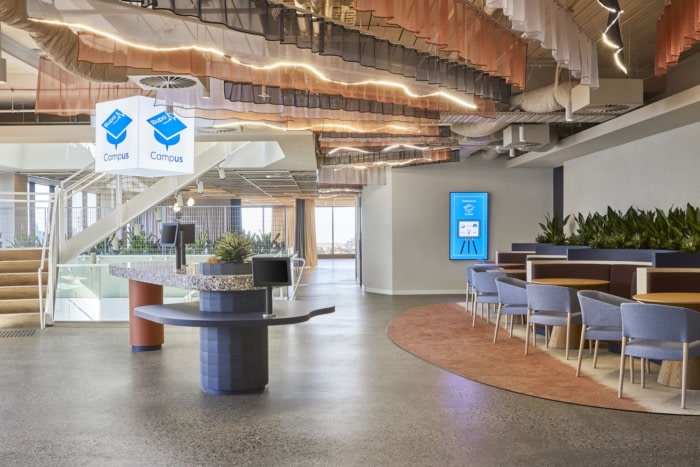
Bupa Campus – Melbourne
Vemi’s Bupa Campus in Melbourne redefines workplace learning through an innovative, interconnected environment that fosters collaboration, inclusivity, and sustainability, while showcasing Indigenous artistry and diverse sensory experiences.
Located in the heart of Melbourne’s CBD is the new Bupa Campus. A purpose-built environment designed to support the professional development of Bupa Asia-Pacific (APAC) workforce. This future-focused learning and development hub—positioned within Bupa’s Melbourne Head Office—marks a significant investment in cultivating a culture of continuous improvement, curiosity, and career growth. As part of Bupa’s vision to be a leading employer across the Asia-Pacific region, the campus supports the upskilling of employees to meet evolving workforce demands and expectations. The space offers employees a flexible, engaging environment that encourages hands-on learning and future-ready thinking.
Design Narrative
At the heart of the Bupa Campus lies a powerful conceptual foundation: the idea of a Nexus—an intricate network of systems and relationships working in harmony to support growth, evolution, and connection. Just as a biological nexus sustains life through interconnected systems, the Campus functions as an immersive ecosystem of connective nodes, seamlessly integrated through technology, materiality, and spatial design. These connections are brought to life through flexible, interactive spaces that encourage hands-on experimentation, and real-time collaboration—cultivating a culture of curiosity, innovation, and continuous learning.
Bupa’s Campus is thoughtfully overlaid with six guiding spatial archetypes:
– Connect (Gathering Spaces)
– Interact (Idea Incubator)
– Inspire (Knowledge Exchange)
– Investigate (Analysis and Research)
– Discover (Learning Forum)
– Support Spaces (Interlinking)
Each of these zones plays a role in supporting varied learning behaviours and workplace interactions.
The Interactive Space philosophy is defined by “buzz” and “hive”—vibrant, collaborative zones where diverse voices are heard and ideas flourish. Pops of colour and dynamic seating arrangements activate these spaces, making them the energetic nexus of the campus.
Conversely, the Learning & Inspire zones are characterised by the concepts of “absorbing” and “understanding.” These are calmer, more focused environments that support deep thought and knowledge retention. Natural, soft palettes, accented by subtle nods to Bupa’s signature tones, create a gentle visual transition, linking back to the central nexus while enabling focused, meaningful learning experiences.
High and Low Sensory Spaces
Everyone learns and processes information in different ways, and that’s especially true when it comes to how we respond to our surroundings. Research by Winnie Dunn highlights that people fall into four general patterns based on how sensitive they are to sensory input and how they manage it—some seek out stimulation, others avoid it, and many sit somewhere in between. With this in mind, Bupa’s Global Campus was designed to offer a variety of spaces that support different sensory needs. The low-sensory room, for example, uses deep maroon tones to create a calm and reflective atmosphere. It’s a quiet retreat where users can adjust lighting, shut the door, and take a moment to recharge. On the flip side, brighter, open zones offer a more energised setting for those who thrive in busier, well-lit environments. The goal was to create a space where everyone can feel comfortable and focused, no matter how they learn best.
Universal Design
Inclusion and accessibility emerged as consistent themes throughout our early workshops with Bupa’s team, particularly in discussions around the functionality of training spaces. From the initial design stages, these principles were embedded into the design approach, ensuring the Campus would be welcoming, practical, and accommodating for all users.
Sustainability
Sustainability was a key consideration throughout every stage of the Bupa Global Campus project, from concept through to completion. We worked closely with Bupa to ensure that environmental responsibility was integrated into the design and execution of the space, reflecting both the company’s values and our commitment to creating sustainable, future-ready workplaces. By prioritising eco-friendly materials, local sourcing, and reusing existing elements, we were able to create a functional, learning environment that minimises its environmental footprint. These sustainability efforts not only support Bupa’s corporate responsibility goals but also contribute to a healthier, more efficient workspace for its employees.
First Nations Artists
The Campus proudly features work by First Nations artists across key elements of the interior. In the Touchdown Room, the flooring design—Sandhills by Gumbaynggirr artist Helena Geiger. Inspired by the desert landscape, Geiger’s work captures the movement of undulating dunes, ancient ravines, and rocky chasms. Her design creates an immersive experience that blurs the boundaries between natural and built environments, grounding the space in stories passed through generations.
Complementing this, the Campus integrates fabrics by First Nations artists through partnerships with Materialised and Willie Weston—two Australian businesses that champion Indigenous design. Materialised features work by the late Jimmy Pike, a Walmajarri artist, known for his expressive depictions of the Australian desert. His Sand Dunes and broader Desert in Colour collection bring vibrancy, storytelling, and a unique sense of place to the interior. Willie Weston’s collaboration with Kathleen Korda of Durrmu Arts further enhances the cultural narrative. Her fabric design Durrmu (KK) draws from ceremonial body painting traditions, using dot motifs that carry significant cultural meaning.
Design: Vemi
Builder: Vemi
Client-Side Project Manager: Plan1
Building Surveyor: McKenzie Group
Services Consultant: Stantec
Photography: Dave Kulesza





Now editing content for LinkedIn.