

Yandex Office 3 – Moscow
Freya Architects designed the Yandex Office 3 in Moscow to transform a typical cold workspace into a vibrant ecosystem that fosters collaboration, innovation, and employee well-being through dynamic colors and playful geometries.
The office space of a large IT company is located in a modern, six-story business center building in the city’s historic district, occupying an entire floor of 2,200 square meters. The building, constructed in 2015, is a typical glass-fronted office building with paneled facades and formal, cold interiors of common areas, housing numerous offices from various companies.
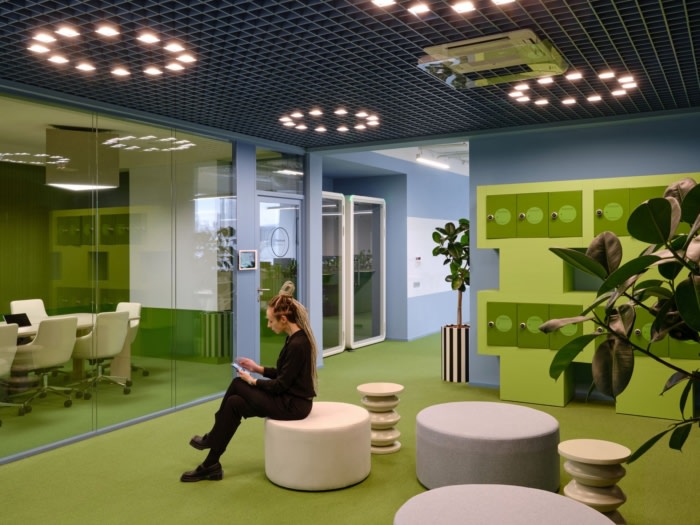
Our primary goal for this project was not only to develop a competent layout for the large space but also to create a completely different atmosphere—a vibrant one, yet comfortable for work and collaboration, with elements of play, a distinct identity, and an atmosphere untypical of ordinary offices and a contrast to the cold interiors of the building’s common areas. We wanted employees to feel like they belong to a space with its own unique character, conveying the company’s core values and mood—compassion for employee comfort, development safety, innovation and vibrant ideas, and a general sense of work as play. In the interiors it was achieved through the use of a diverse palette of complementary bright colors, playful geometric forms in partitions, furniture, lighting elements, and various objects throughout the space, along with unexpected inclusions of contrasting patterns.
This office is conceived as a sequence of experiences rather than a single workspace. At its core, the concept balances rational efficiency with expressive character, combining highly functional open work zones with bold, immersive moments that invite pause, interaction, and mental reset.
The office space consists of two rectangular wings of the building, connected by a functional isthmus. To create the entire office structure with convenient and logical navigation, the plan was organised as a branched layout, where several wings radiate from a central circulation spine – the main U-shaped skeleton of neutral-colored spaces, containing the office’s technical areas and coffee points – to which we add brightly colored zones of open-plan spaces, meeting rooms, and social and relaxation areas.This office space is conceived more as a connected ecosystem than a single open floor—a workplace organized around neighborhoods, movement, and choice. This creates a sense of campus-like diversity while keeping everything functionally connected.
The whole arrangement of spaces create gradients of privacy: open desks near daylight and façades, semi-enclosed collaboration rooms along the spine and enclosed meeting rooms, focus rooms, and support spaces at the central core of wings and deeper inside. This creates choice—collaborate, focus, or socialize depending on the task.
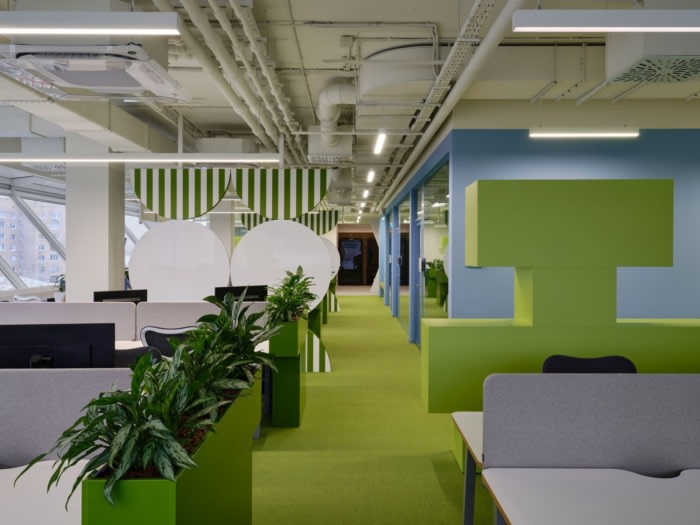
The open-plan spaces are divided by 2 distinct color combinations and form-forming elements of varying geometries—light green and light blue spaces with the triangles as basic elements and dark blue and orange spaces with circle elements. The colors of the open spaces are supported by the same color scheme in the meeting rooms, relaxation areas, and restrooms associated with each zone. This brought a unique character to the different zones and a clear language and recognition to facilitate navigation through the space.
Each wing hosts clusters of workstations arranged in open-plan layouts, desks are organized by the windows to maximize the perceiving of daylight. They are clearly defined but not isolated, allowing teams to feel ownership of their space while staying visually and physically connected.
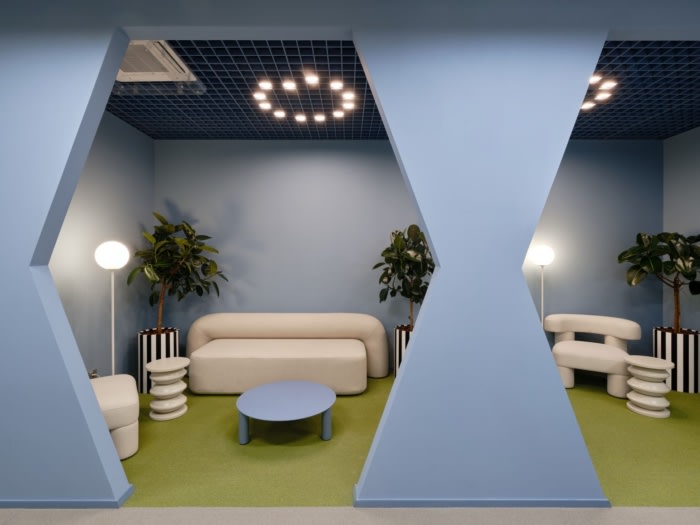
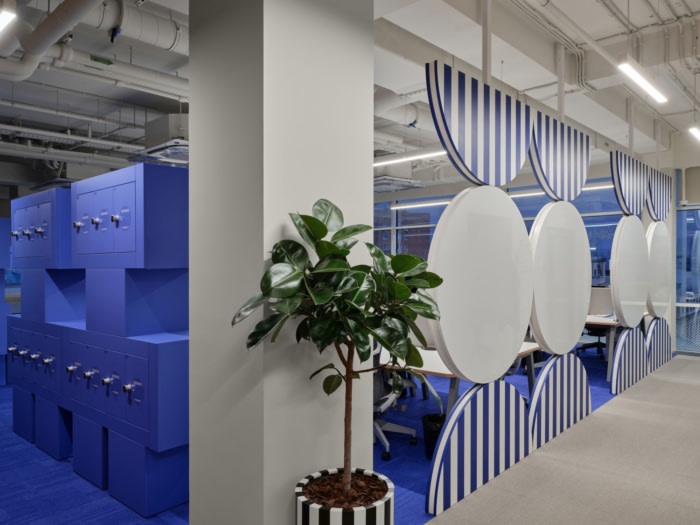
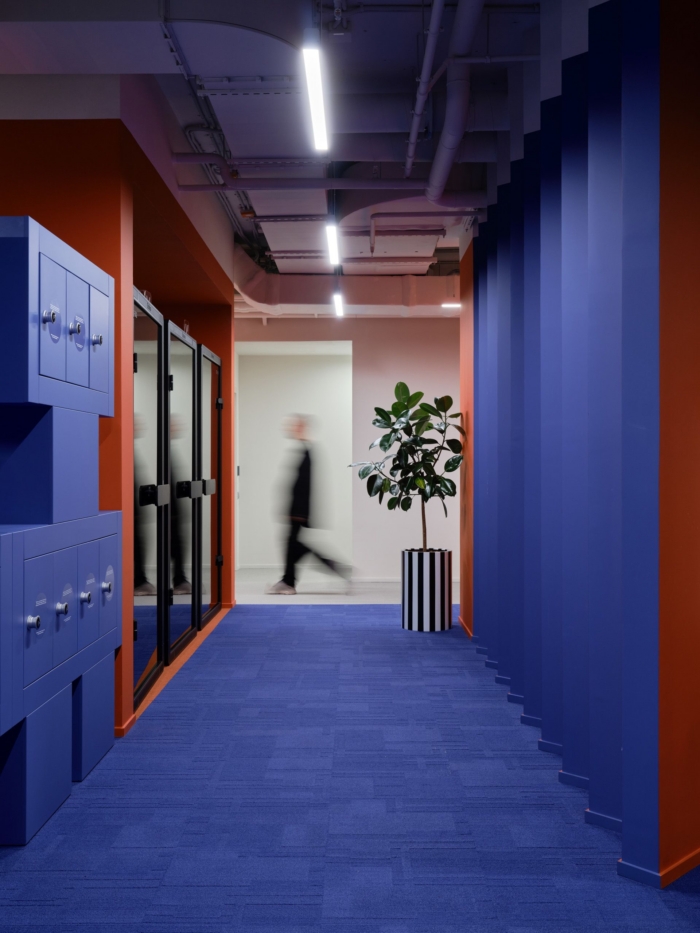
Open spaces are effectively separated from the circulation areas using custom-made, geometrically shaped partitions. Some partitions resemble multicolored accordions, others are composed of large round and semicircular elements on steel supports, which also act as whiteboards, while others are shaped like hourglasses and triangles and separate seating areas. All of this creates an atmosphere of lightness and playfulness, intriguing visitors at every turn.
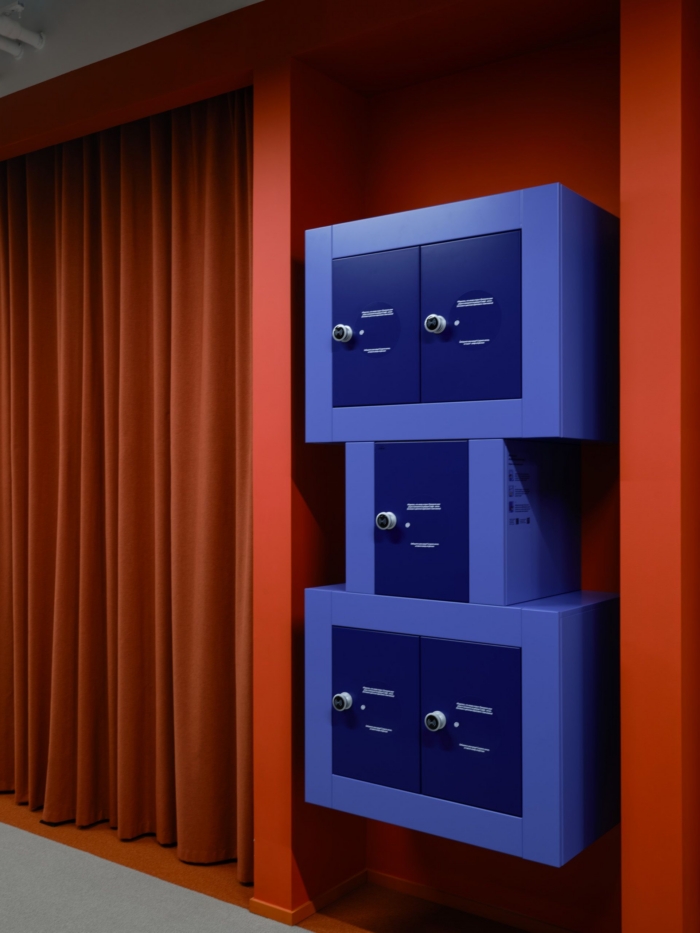
The variety of shapes is complemented by T-shaped pedestals with greenery and custom-made lockers in a color scheme that matches each zone.
A playful element is also evident in the design of the ribbed seats and backrests and the semicircular lightboxes in the benches built into niches.
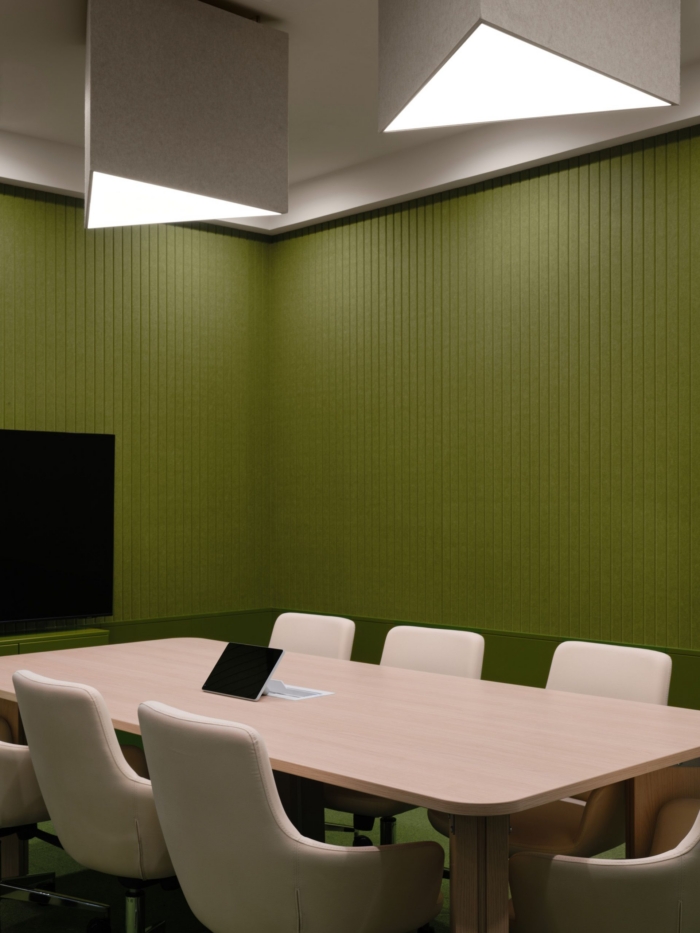
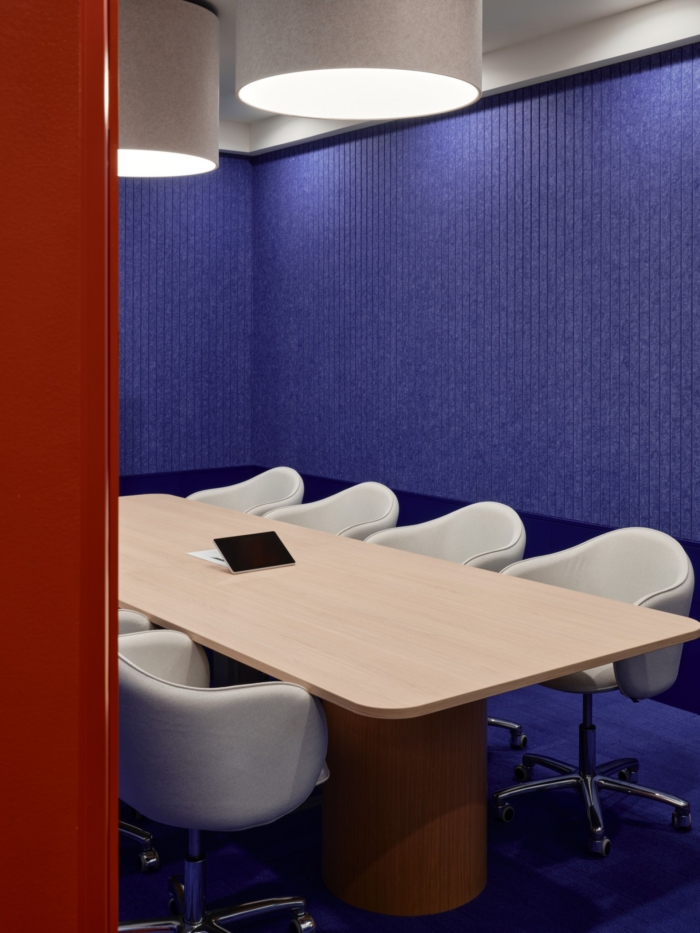
Most of the closed meeting rooms are located in the central cores of each wing and feature a color palette corresponding to their respective zones. The meeting rooms are well-protected acoustically through the use of felt acoustic wall panels, double-glazed stained glass windows, and perforated acoustic ceiling panels. To enhance the sense of belonging to each zone, a specific visual code was used in the lighting and furniture: meeting rooms in the green-blue zone feature massive triangular felt overhead lights, triangular table legs, and angular task chairs, while the blue-orange zones feature ceiling tube lights, massive round table legs, and more fluidly shaped chairs. Daylight freely enters the meeting rooms through stained glass windows, and curtains in felt panel shades allow for different lighting and privacy scenarios depending on the task.
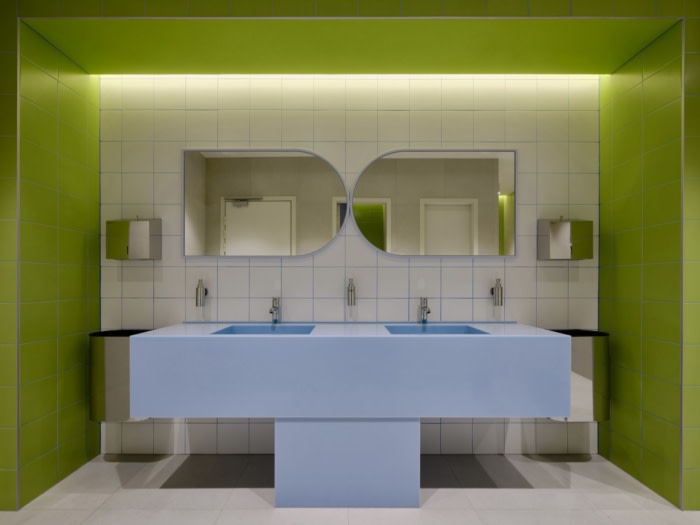
In addition to comfort and meeting all equipment needs, the toilets and showers also pay special attention to color and form, aligning them with the space to which they belong. The sink units are set within U-shaped portals made of colored tiles with contrasting grout, the T-shape of the sinks repeats the shape of lockers in the open spaces, and mirrors echoes the playful geometry of the partitions.
The entrance areas greet visitors with compact, vibrant purple portals, serving as the first monochrome volume along the route. The built-in security desk with furniture, walls, and ceiling are all painted in the same color, lending visual integrity to the entire portal.
The areas for rest are designed using the same box-like principle, with all the elements organizing the area painted in a single color. This creates a cocoon-like, enveloping space ideal for relaxation or casual conversation during work breaks.
In these areas, we used grilyato ceilings, whose orthogonal grid supports the geometric elements of the office space, and integrated lighting fixtures into them, creating pixelated shapes of circles and crosses, further adding a playful element to the interior.
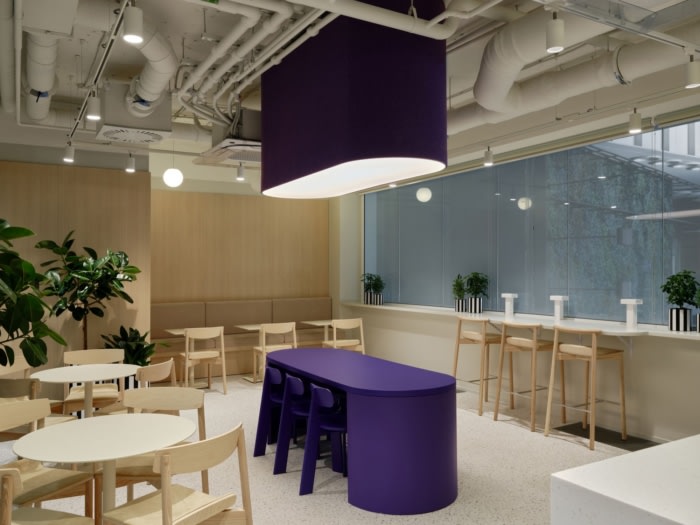
The office’s coffee points are located in a neutral color zone and are all decorated in a unified style—without aligning with the bright color schemes of the common areas, but with a central purple accent against a calm backdrop. Here, employees can take a break from the vibrant colors of the other spaces, spending time surrounded by the warm, light textures of wood and furniture. The coffee points are equipped with a full kitchen and bar area, a large communal table, comfortable upholstered benches, and individual tables to accommodate various seating arrangements. The central core of each coffee point is a cohesive group of elements—a table or bar counter with chairs and a massive felt lamp of the same shape and size above it—all in a uniform purple color, serving as a color accent for the space.
The space incorporates many live plants in custom-made pedestals and in big cylinder black and white striped flowerpots everywhere, which adds a small intriguing accent to large surfaces filled with one color, uniting them.
Design: Freya Architects
Design Team: Kristina Koivistoinen-Khatlamadzhiian, Marina Rudneva, Anastasia Tkachenko
Photography: Maxim Loskutov






Now editing content for LinkedIn.